Choosing the right knockout configuration is not only about counting holes on a box. It affects conduit routing, wiring convenience, installation efficiency, future expansion, and even whether the box will truly fit the project without rework. This guide explains how to evaluate knockout layout from a buyer’s point of view, so you can choose more confidently before ordering.
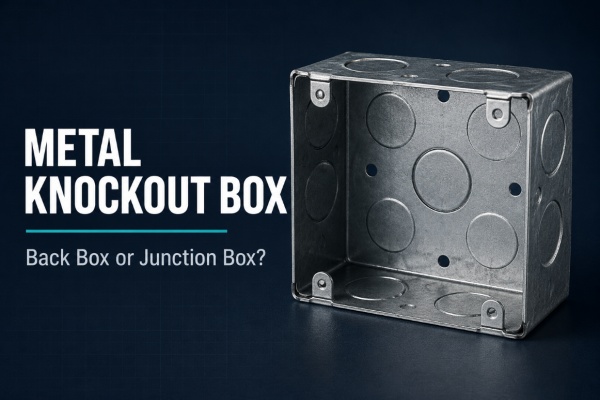
In a metal junction box or metal knock out box, knockout configuration means more than the quantity of knockouts. It includes their number, size, position, and direction. Two boxes may look similar in dimensions, but one may be much easier to install because its knockout layout matches the conduit path and device arrangement better. That is why experienced buyers do not read knockout details as a minor spec. They treat it as part of installation planning.
How Many Conduit Entry Points Do You Actually Need?
The first step is simple but often handled too roughly: count the real conduit entry points the project needs. Many buyers only think about the conduits used in the current drawing, but a practical selection should also consider internal wire routing, branch lines, and whether the box will serve only as a pass-through point or also as a splice point.
If a box only needs one incoming conduit and one outgoing conduit, the knockout requirement is straightforward. But once the box is used for multiple branches, equipment connections, or wall-to-ceiling transitions, the layout becomes more important. A box with too few usable entry points creates immediate installation difficulty. A box with the wrong entry point distribution can be just as inconvenient, even if the total number looks sufficient on paper.
Why Does Entry Direction Planning Matter?
Buyers often focus on how many knockouts a box has, but installers care just as much about where they are. If conduit needs to enter from the top, but the practical knockout positions are concentrated on the sides, installation becomes less clean and less efficient. The same applies when conduits need to turn around corners, travel upward, or align with equipment mounting positions.
Good entry direction planning reduces sharp wire bending, shortens conduit routing, and makes the inside of the box easier to manage. It also lowers rework risk. In many projects, the wrong knockout direction does not make installation impossible, but it makes it awkward, slower, and less professional.
When Should You Choose a Standard Knockout Layout vs a Custom One?
For many routine projects, a standard knockout layout is the most efficient option. It is easier to source, simpler to compare across suppliers, and usually works well when installation patterns are common and repeatable. Standard layouts are often enough for general residential, commercial, and basic industrial jobs.
But not every project is standard. Some buyers need a box with more side entries, fewer unused holes, special knockout sizes, or a different distribution to match equipment layout. In those cases, a custom knockout layout can reduce installation time and avoid field modification. That means less drilling on site, better consistency, and lower workmanship risk.
How Should You Think About Future Expansion?
A good knockout configuration should solve today’s installation without making tomorrow’s changes difficult. This does not mean every box should be oversized or overloaded with extra knockouts. It means buyers should think realistically about whether the system may grow, branch further, or require additional conduits later.
If a project is likely to expand, a slightly more flexible knockout arrangement can be valuable. It can leave room for future device additions, branch circuits, or routing changes without replacing the box. This is especially useful in commercial projects, plant maintenance work, and phased installations.
Common Buying Mistakes
Buyers usually do not make mistakes because they ignore knockout configuration completely. More often, they simplify it too much. They check the box size, verify the material, and assume the knockout layout will “probably work.” That assumption is where many avoidable problems begin.
M&K focuses on Metal Junction Box and Metal Knock Out Box solutions for different installation requirements. If you are comparing standard layouts, reviewing conduit entry directions, or considering a more suitable custom knockout configuration, we can help you evaluate the options more clearly.