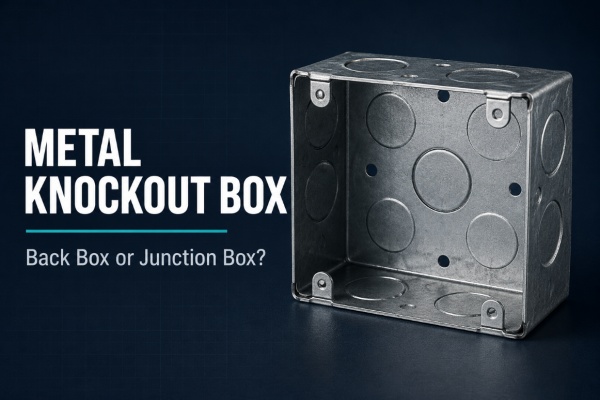
Buyers often ask whether a metal junction box or a plastic junction box is the better choice. The most practical answer is that neither material is automatically better in every situation. The right choice depends on the installation environment, protection level, grounding needs, cost expectations, and long-term service priorities. This guide compares the two from a project decision point of view, so buyers can understand where metal is stronger, where plastic has advantages, and how to choose more accurately by application.
In product discussions, this comparison is sometimes treated too simply, as if one material should always replace the other. In reality, metal junction boxes and plastic junction boxes are chosen for different reasons. Metal is often preferred where impact resistance, heat tolerance, structural strength, and grounding compatibility matter more. Plastic is often chosen where lower weight, corrosion resistance, electrical insulation, or simpler installation in certain environments becomes a stronger advantage.
So the more useful question is not “Which is universally better?” The more useful question is “Which is better for this project?” That is the perspective this guide uses.
Strength Comparison
In general, metal junction boxes are more often chosen when structural strength is a priority. They are commonly associated with better impact resistance, better shape retention under pressure, and a stronger overall body feel in demanding installations. This is one reason metal boxes are often favored in commercial, industrial, and tougher-use environments.
Plastic junction boxes can still be suitable in many applications, especially where the installation is more protected and extreme mechanical stress is not expected. Their advantage is not maximum strength, but practical sufficiency in the right context. For ordinary protected use, plastic can be perfectly functional. For installations more exposed to impact, handling stress, or rougher site conditions, buyers often lean toward metal because the added strength creates more confidence.
Fire and Heat Considerations
Metal junction boxes are frequently discussed in connection with better heat tolerance and stronger suitability in applications where fire resistance or higher-temperature conditions matter more. Buyers often see metal as the more robust option when the installation environment may be more demanding from a heat or safety perspective.
Plastic boxes, on the other hand, may still be widely used in suitable systems and code-compliant applications, but buyers should think more carefully about environment and expectation. Plastic’s strengths are usually not described in terms of maximum heat resistance. They are more often related to lighter weight, corrosion immunity in certain settings, and insulation advantages.
In practical buying terms, if a project places more emphasis on ruggedness, heat tolerance, and a more conservative material choice for demanding conditions, metal usually becomes more attractive. If the application is lighter and those issues are less dominant, plastic may remain a practical option.
Corrosion Resistance
Corrosion resistance is one of the most important reasons buyers may choose plastic. Because plastic does not rust, it can offer a clear advantage in some environments where corrosion is a key concern. That is especially relevant in humid or chemically sensitive applications where the buyer wants to avoid metal surface deterioration entirely.
Metal boxes can also perform well in many environments, but their corrosion resistance depends on material and finish selection. Galvanized, plated, coated, or stainless options can all improve anti-rust performance, but the buyer must make that choice intentionally. Plastic does not need the same type of anti-rust strategy, which is why it often appeals in applications where corrosion resistance is the first concern.
So if a buyer is mainly asking, “Which one handles corrosion more simply?” plastic often has a natural advantage. But if the project also needs stronger structural behavior, grounding compatibility, or a more rugged enclosure body, metal may still be the better fit when chosen with the right finish and material system.
Installation Convenience
Installation convenience is another area where the answer depends on the application. Plastic boxes are often appreciated for being lighter and easier to handle in certain installations. That can make them attractive where simpler handling, easier transport, or lower installation effort is valued.
Metal boxes, however, are often preferred where the buyer wants a stronger, more rigid mounting result. In some project environments, installers may actually prefer metal because it feels more stable and better suited to demanding conduit systems or heavier-duty use. So the “easier to install” answer is not universal. It depends on whether the priority is lighter handling or stronger structural installation confidence.
In simple terms, plastic can be more convenient in lighter-duty scenarios, while metal can be more reassuring in tougher, more infrastructure-heavy conditions.
Grounding Considerations
Grounding is one of the clearest technical reasons metal and plastic cannot be treated as interchangeable in every application. Metal boxes are often discussed in connection with grounding and conductive system compatibility. In many systems, that makes metal a natural fit where grounding continuity and metal raceway compatibility are part of the installation logic.
Plastic boxes, by contrast, are non-conductive. That can be seen as an advantage in some applications, because plastic does not conduct electricity and offers inherent insulation-related benefits. But that same characteristic means grounding considerations must be understood differently. So again, the better material depends on the system design, not on a simple preference.
If grounding and metal system integration are important, buyers often favor metal. If electrical insulation and corrosion immunity are stronger priorities in the application, plastic may become more attractive.
Cost and Lifecycle Value
Cost comparison should not stop at the unit price. Buyers often find that plastic boxes look attractive when the priority is lower upfront cost, lighter weight, or corrosion simplicity. That can make them a very sensible choice in suitable applications. But low cost only creates good value if the box is also right for the installation environment and system demands.
Metal boxes may cost more in some cases, especially if the project requires stronger material, better finishes, or more demanding performance levels. But that higher upfront cost may be justified if the box delivers stronger service life, better mechanical protection, or more reliable integration in the installation system. In other words, lifecycle value depends on fit, not just on price.
This is why buyers should compare both budget and environment at the same time. If the project is ordinary, protected, and lower-demand, plastic may be the better value. If the project is harsher, more exposed, or more infrastructure-heavy, metal may create the better long-term result.
M&K focuses on Metal Junction Box and Metal Knock Out Box solutions for different installation environments and project needs. If you want to compare material options more clearly or decide whether a metal box is the better fit for your application, you can contact us for further support.