To choose a reliable metal junction box manufacturer, look at whether the manufacturer can support the required standards, suitable materials, accurate customization, stable production, clear quality control, realistic lead times, and practical technical communication. A good manufacturer should not only make metal boxes, but also help the product match the intended installation environment, protection level, wiring layout, material requirement, and delivery schedule.
Certification and compliance should also be understood correctly. Very few manufacturers prepare every global certification for every product model in advance. What matters more is whether the product can be designed, produced, tested, or documented according to the standards required by the target market or application. The right question is not only “Does the factory have certificates?” but “Can this specific metal junction box meet the required standard, rating, or compliance expectation?”
What Standard and Certification Support Should a Metal Junction Box Manufacturer Provide?
A reliable metal junction box manufacturer should understand that different markets and applications may require different standards, ratings, tests, or compliance documents. Indoor boxes, outdoor boxes, corrosion-resistant boxes, and boxes used in specific electrical systems may not follow the same requirements.
This does not mean the manufacturer must already have every global certification for every product. In real manufacturing, it is more practical to confirm the target market first, then check whether the specific metal junction box can be designed, produced, tested, or documented according to the required standard.
Do not judge a manufacturer only by whether it claims to have many certificates. A more professional evaluation is whether the manufacturer understands the required standard for the target market and can support the product design, material selection, protection level, testing, or compliance documentation when needed.
| Region / Requirement Type | Common Reference | How to Evaluate It |
|---|---|---|
| North America | UL, CSA / cUL, NEC-related requirements | Check whether the specific product needs listing, testing, or installation-related compliance support. |
| Enclosure Protection | NEMA Type 1 / 3R / 4 / 4X | Used to describe protection levels such as indoor use, rain protection, water resistance, dust protection, or corrosion resistance. |
| International IP Protection | IEC 60529 / IP Rating | Used to define dust and water ingress protection, such as IP65, IP66, or IP67 when required. |
| European Market | CE-related requirements when applicable | Confirm whether the specific product falls under applicable EU requirements and what documentation is needed. |
| United Kingdom | UKCA-related requirements when applicable | Check whether the product requires UK market conformity support based on its category and use. |
| Australia / New Zealand | RCM-related requirements when applicable | Confirm whether the product is within the relevant electrical equipment compliance scope. |
| Other Target Markets | Local electrical, safety, or installation requirements | The manufacturer should be able to review the requested standard and confirm whether product design, testing, or documentation can be supported. |
In short, reliable certification support does not mean every certificate is already available. It means the manufacturer can understand the target standard and help align the metal junction box design, material, protection level, testing, and documentation with the actual market requirement.
How Should a Manufacturer Support Metal Junction Box Material Selection?
Material capability is one of the strongest signs of a reliable metal junction box manufacturer. Different environments require different materials. A manufacturer that only offers one basic material may not be suitable for applications involving corrosion, humidity, outdoor exposure, chemical environments, or weight limits.
| Material | Suitable Use | Main Advantage |
|---|---|---|
| Galvanized Steel | General indoor or standard electrical applications | Good forming performance and basic corrosion resistance |
| Painted Steel | Indoor or controlled environments | Clean appearance and flexible surface finish |
| Stainless Steel 304 | Humid or corrosion-prone environments | Better corrosion resistance than ordinary steel |
| Stainless Steel 316 / 316L | Coastal, chemical, or harsh industrial environments | Stronger corrosion resistance in demanding conditions |
| Aluminum | Lightweight or corrosion-resistant applications | Lower weight and suitable corrosion behavior |
A reliable manufacturer should help match the material to the actual environment. A basic indoor junction box may not need stainless steel, while an outdoor, wet, coastal, or corrosive environment may require better material, stronger coating, or a higher protection design.
What Customization Capabilities Should a Reliable Metal Junction Box Manufacturer Have?
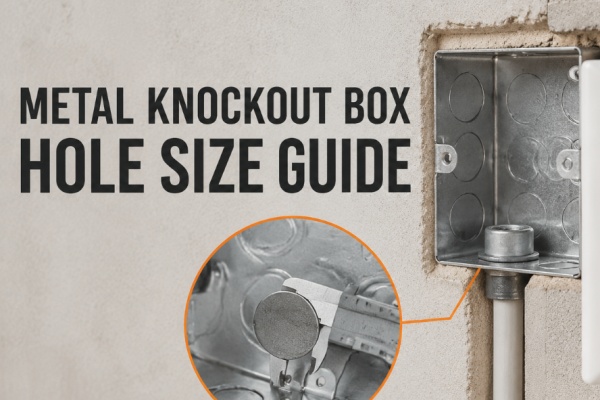
Customization is important because metal junction boxes often need to match specific installation spaces, conduit directions, wiring layouts, protection levels, or equipment structures. A reliable manufacturer should support custom dimensions, knockout holes, material thickness, surface finish, cover style, mounting method, and internal accessories.
• Custom width, height, and depth
• Custom material thickness
• Custom mounting feet or flanges
• Hinged, screw-down, or gasketed covers
• Custom knockout size and position
• Pre-punched or pre-drilled holes
• DIN rails, back panels, terminal blocks
• Grounding points and internal brackets
• Powder coating or custom finish
• Color matching when required
• Logo, model label, warning label
• Custom packaging and carton labels
A strong manufacturer should not simply say “yes” to every custom request. They should explain what is feasible, what may require tooling, what affects lead time, and whether the design may influence sealing, strength, or installation.
Why Do Production Capacity and Process Control Matter?
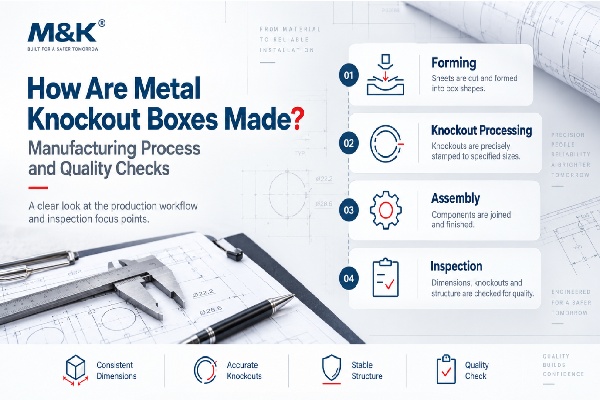
A reliable metal junction box manufacturer should have stable production capacity and a controlled production process. Capacity is not only about how many boxes can be produced. It is also about whether the factory can maintain consistent quality when order quantity increases or when custom requirements become more complex.
• Stable sheet metal forming capability
• Controlled punching, bending, welding, and finishing
• Repeatable dimensions for standard models
• Clear management of custom orders
• Ability to support samples and repeat production
• Production planning that matches promised lead time
For time-sensitive projects or repeated orders, production control is often more important than a low unit price. Poor process control can lead to inconsistent dimensions, delayed delivery, wrong hole positions, surface defects, or packaging mistakes.
What Quality Control Should a Metal Junction Box Manufacturer Provide?
Quality control should cover the whole manufacturing process, not only the final inspection. A manufacturer may say “we inspect quality,” but the more important question is what they inspect and when they inspect it.
| QC Stage | What Should Be Checked |
|---|---|
| Incoming Material Inspection | Material type, sheet thickness, coating, and surface condition |
| In-Process Inspection | Cutting accuracy, punching quality, bending consistency, and welding condition |
| Dimensional Inspection | Width, height, depth, mounting holes, cover fit, and knockout position |
| Surface Finish Inspection | Coating quality, scratches, rust marks, adhesion, and color consistency |
| Assembly Inspection | Cover alignment, screw fit, gasket compression, and internal accessories |
| Performance Testing | IP, NEMA-related sealing, water, dust, or corrosion tests when required |
| Packaging Inspection | Labels, quantity, carton strength, surface protection, and accessory completeness |
A reliable manufacturer should be able to explain how they prevent common defects such as sharp burrs, misaligned knockouts, poor cover fit, weak coating, oil canning, poor sealing, inconsistent dimensions, or mixed packaging.
Why Are Samples and Prototypes Important for Custom Metal Junction Boxes?
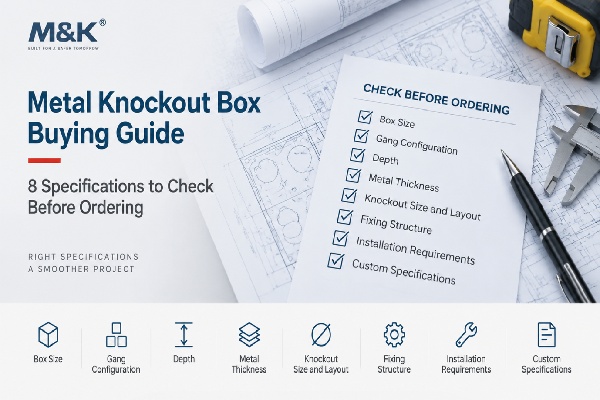
For custom metal junction boxes, sample confirmation is very important. A drawing may look correct, but the real product still needs to be checked for size, hole position, cover fit, mounting method, internal space, surface finish, and packaging.
• Drawing review before production
• Prototype or sample production when needed
• Sample inspection before mass production
• Feedback on design risks
• Adjustment before final production
• Confirmation of material, finish, label, and packaging details
Prototype testing is especially useful when the box has custom knockouts, gasket sealing, DIN rails, special mounting points, or a required IP/NEMA protection level.
How Should Metal Junction Box Lead Time and Delivery Reliability Be Evaluated?
Lead time is another important sign of manufacturer reliability. A low price is not useful if the manufacturer cannot deliver on time or if the schedule changes repeatedly.
A reliable manufacturer should give a realistic production schedule and explain which details may affect delivery time, such as custom coating, special materials, new tooling, prototype revisions, or additional testing requirements.
What Technical Support Should a Metal Junction Box Manufacturer Provide?
Technical support matters because metal junction boxes are not only about size and price. Material selection, hole layout, internal space, sealing, coating, mounting method, and protection rating can all affect the final product.
Material selection, thickness recommendation, knockout layout review, cover design, and internal accessory layout.
Surface treatment choice, gasket structure, IP or NEMA-related design review, and corrosion protection suggestions.
Drawing confirmation, sample feedback, packaging details, label requirements, and production risk communication.
How Should Cost and Quality Be Balanced When Choosing a Manufacturer?
Price is important, but choosing only by the lowest price can create higher risk. A cheaper metal junction box may use thinner material, weaker coating, poor punching, unstable dimensions, insufficient sealing, or weak packaging.
• Material type and sheet thickness
• Surface finish quality
• Knockout accuracy
• Cover fit and sealing design
• Corrosion resistance
• Testing or rating requirement
• Packaging quality
• Delivery reliability
• Technical and after-sales support
A reliable manufacturer should help balance cost and quality instead of pushing the cheapest option without explaining the trade-offs.
Checklist for Choosing a Reliable Metal Junction Box Manufacturer
The following checklist can help evaluate whether a manufacturer is suitable for metal junction box production, customization, and long-term cooperation.
• Does the manufacturer understand the target market standard or rating requirement?
• Can they explain whether the specific product needs UL, NEMA, IP, CE, UKCA, CSA, RCM, CCC, or other market-related compliance support?
• Do they offer suitable materials such as galvanized steel, stainless steel, or aluminum?
• Can they support custom size, thickness, knockouts, covers, mounting, and internal accessories?
• Do they provide drawing review, sample confirmation, or prototype support when needed?
• Is their quality control process clear from material inspection to final packaging?
• Can they explain how they prevent burrs, poor coating, bad sealing, or dimension errors?
• Is their production capacity suitable for the required quantity and schedule?
• Are lead times realistic and clearly communicated?
• Do they provide technical support for material, design, and protection requirements?
• Do they have experience with similar applications or environments?
• Is the price reasonable based on material, quality, testing, and reliability?
M&K Metal Junction Box Manufacturer Support
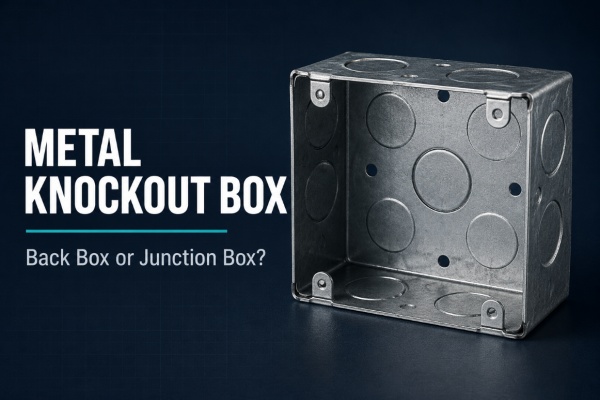
M&K focuses on metal junction boxes and metal knock out boxes for practical electrical applications. Product support can include standard models, custom dimensions, material thickness options, knockout layout, surface treatment, cover design, mounting methods, internal accessories, labels, packaging, and application-specific requirements.
A reliable metal junction box manufacturer should not only provide a quotation. It should help clarify product requirements, reduce design and production risks, and support stable quality from sample confirmation to final delivery.
If you need help with metal junction box specifications, material selection, custom knockout design, surface finish, protection requirements, or production details, contact M&K for more information.