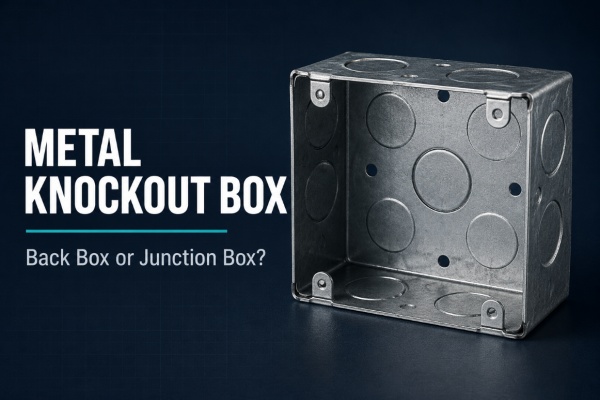
A metal knockout box may also be described as a metal back box, junction box, switch box, socket box, outlet box or device box. However, these terms are not always exact synonyms. Each name may emphasize a different aspect of the box, such as its cable-entry structure, electrical function, mounting method, compatible accessory or regional naming convention.
This distinction matters when reading product catalogs, comparing electrical boxes or interpreting project specifications. Two suppliers may use different names for similar boxes, while two products carrying the same general name may differ in depth, fixing centers, knockout arrangement or intended installation method.
This guide explains what the most common electrical box names mean, how they overlap and which specifications must still be checked beyond the product name.
Table of Contents
- Why One Electrical Box Can Have Several Names
- What Does Metal Knockout Box Mean?
- Metal Knockout Box vs Metal Junction Box
- Back Box, Flush Box, Surface Box and Pattress Box
- Switch Box, Socket Box, Outlet Box and Device Box
- Gang, Way, Knockout Count and 4 Square
- Regional Electrical Box Terminology
- How to Read a Complete Product Name
- How to Identify the Correct Box
- Frequently Asked Questions
Why One Electrical Box Can Have Several Names
Electrical boxes are not named through one universal system. A product name may be based on the box material, its cable-entry design, what it contains, where it is installed or the type of accessory mounted to it.
| Naming Basis | Example Terms | What the Name Emphasizes |
|---|---|---|
| Material | Metal box, steel box, GI box | The material or surface condition of the enclosure |
| Cable-entry structure | Knockout box | The presence of removable cable or conduit entries |
| Electrical function | Junction box | Housing wire joints, branches or terminations |
| Mounted accessory | Switch box, socket box, outlet box | The device intended to be fitted to the box |
| Installation method | Back box, flush box, surface box, pattress box | Where and how the box is mounted |
| Format or size family | 1 gang, 2 gang, 4 square | Accessory layout, device positions or box form |
The key rule: an electrical box can belong to several naming groups at the same time. A recessed metal box with removable entries used behind a socket may reasonably be called a metal knockout box, metal back box, flush box and socket box.
What Does Metal Knockout Box Mean?
The term metal knockout box describes the box through its material and cable-entry structure:
- Metal identifies the general enclosure material.
- Knockout refers to a partially formed section that remains closed until an entry is required.
- Box identifies the enclosure used to contain wiring, connections or a wiring accessory.
A knockout is normally formed during manufacturing. The removable section allows an installer to create an entry without drilling a completely new hole. Depending on the box design, knockouts may be located on the sides, rear or base and may accept cables, conduit fittings, glands or other approved entry components.
The name does not, by itself, identify the box depth, gang configuration, mounting method, knockout size, environmental protection or compatible faceplate. It also does not prove that every opening can be used with every conduit fitting. Those details must be confirmed from the product drawing or specification.
Knockout or Knock Out?
Knockout is generally the clearer spelling when the word is used as a noun or product descriptor, as in “knockout hole” or “metal knockout box.” The two-word form is normally used as a verb, as in “knock out the selected disc.”
Nevertheless, many supplier catalogs use “knock out box” as a product name. Both versions may appear in searches, but using one consistent spelling throughout a technical article makes the content easier to read.
Metal Knockout Box vs Metal Junction Box
The difference is primarily one of naming focus. Metal junction box is a function-based term, while metal knockout box is a structure-based term.
| Comparison | Metal Knockout Box | Metal Junction Box |
|---|---|---|
| Main naming basis | Removable entry structure | Electrical connection function |
| What the term confirms | The box has prepared knockout entries | The box is intended to contain joints, branches or terminations |
| Typical uncertainty | It does not identify the exact electrical function | It does not confirm whether removable knockouts are provided |
| Possible overlap | A metal box can contain wire connections and also provide removable knockouts, so it may fit both descriptions. | |
Many building-wiring boxes are both junction boxes and knockout boxes. However, the wider junction-box category also includes products with threaded entries, membrane entries, cable glands or custom-drilled openings. It may also include sealed outdoor enclosures and industrial boxes that are very different from a concealed switch or socket box.
For that reason, “junction box” should not automatically be interpreted as one exact product shape. Readers who need a more focused comparison can refer to Metal Junction Box vs Knock Out Box.
Back Box, Flush Box, Surface Box and Pattress Box
These names primarily describe where the box sits in relation to the wall and the wiring accessory.
Metal Back Box
A metal back box is installed behind a switch, socket, control plate or similar wiring accessory. The term emphasizes the box’s position behind the visible faceplate. Back boxes provide fixing points for the accessory and space for terminals, conductors and connectors.
Although “back box” is frequently associated with recessed wall installation, the name alone does not always establish whether the product is flush mounted or surface mounted. The mounting method should still be confirmed.
Flush Box
A flush box is designed to sit inside a wall, partition or other mounting surface so the attached accessory finishes close to the wall face. The term describes the installation method rather than the box material. A flush box may be metal or non-metallic and may or may not contain removable knockouts.
Surface Box
A surface box is fixed on the face of a wall instead of being recessed into it. It remains visible after installation unless covered by the accessory or another enclosure. Surface boxes are useful where wall recessing is unavailable or where the wiring system is intentionally surface mounted.
Pattress Box
Pattress box is common in British and some Commonwealth-market wiring accessory catalogs. It frequently refers to a surface-mounted box positioned behind a switch or socket. The term may also appear for spacer or extension products that increase the mounting depth behind an accessory.
Usage is not perfectly consistent between suppliers. A product described as a pattress should therefore be checked for mounting type, material, dimensions and compatible accessory rather than being assumed to be a particular type of metal box.
Switch Box, Socket Box, Outlet Box and Device Box
These terms identify the accessory or device associated with the box. They are useful descriptions, but they do not provide a complete mechanical specification.
| Term | Usual Meaning | Important Limitation |
|---|---|---|
| Switch box | A box intended to support a wall switch or switching accessory | It does not define the switch type, gang count or fixing centers |
| Socket box | A box installed behind a socket outlet, especially in British-influenced terminology | Compatible socket formats vary between markets |
| Outlet box | A common North American term for a box at an electrical outlet point | It may be used for receptacles, lighting or other outlet applications |
| Receptacle box | A box intended to mount a receptacle | The required cover, box capacity and device format must still be checked |
| Device box | A broader term for a box supporting a switch, receptacle or related wiring device | It does not identify one specific device or regional format |
One box design may be suitable for both a switch and a socket when its dimensions, screw positions, internal depth and applicable product system are compatible. The product name alone is not enough to establish interchangeability.
Gang, Way, Knockout Count and 4 Square
Gang, way and knockout count are often placed close together in product listings, but they describe different characteristics.
| Term | What It Describes | What It Does Not Mean |
|---|---|---|
| Gang | The accessory layout, plate format or number of device positions, depending on the regional system | It is not the number of knockouts and does not automatically equal the number of circuits |
| Way | The switching arrangement, such as one-way or two-way control | It does not describe box width, box depth or knockout quantity |
| Knockout count | The number of removable entry positions provided on the box | It does not indicate how many switches or sockets can be mounted |
| 4 square | A square box form or nominal size family commonly found in North American-style catalogs | It does not automatically mean four gangs or four knockout openings |
For example, a product could be a 2 gang, 35mm-deep metal knockout box with six knockouts. In that description, “2 gang” identifies the accessory layout, “35mm” identifies nominal depth and “six knockouts” identifies the number of cable-entry positions. None of these values can replace the others.
A 4 square box should also not be treated as an automatic synonym for a 2-gang box. A square box may support different device configurations through suitable covers, rings or mounting structures. The actual box dimensions, cover arrangement and device compatibility remain decisive.
Regional Electrical Box Terminology
The following table is a terminology guide, not a standards-conversion chart. Terms can vary between manufacturers even within the same country.
| Market or Catalog Type | Frequently Seen Terms | What to Confirm |
|---|---|---|
| United Kingdom and Ireland | Metal back box, flush box, pattress box, socket box, 1 gang, 2 gang | Flush or surface mounting, accessory format, depth and fixing centers |
| North America | Outlet box, switch box, receptacle box, device box, gang box, 4-inch square box, handy box | Nominal box size, volume, cover type, knockout trade size and listing requirements |
| Middle East, Africa and South Asia | Metal knockout box, metal switch box, metal socket box, GI box, metal back box | Actual material, coating, wall thickness, metric dimensions and local accessory format |
| International export catalogs | Metal junction box, metal knockout box, electrical back box, switch and socket box | Whether the term is a broad category name or a precise model description |
The term GI box deserves particular care. It is often used as shorthand for a galvanized metal box, but it does not always communicate the exact steel grade, coating method or coating thickness. Those properties should be stated separately when they are important.
How to Read a Complete Product Name
A well-structured product name combines several descriptors instead of relying on one broad term. Consider the example:
2 Gang 35mm Metal Knockout Back Box
- 2 Gang describes the intended accessory or plate layout.
- 35mm describes the nominal box depth.
- Metal identifies the general enclosure material.
- Knockout confirms the presence of removable entry points.
- Back Box indicates that the box is intended to sit behind a wiring accessory.
Even this relatively detailed name does not confirm every requirement. The exact width, height, internal clearance, fixing-center distance, sheet thickness, knockout size, knockout position, lug structure and surface finish must still be checked.
Additional structural phrases may appear after the main product name:
- With adjustable lug identifies a movable device-fixing structure.
- With center support bar identifies an internal reinforcing or connecting component.
- With brass standoff identifies a raised brass fixing point, not automatically an earth terminal.
- Heavy-duty fixing screw describes a particular fixing feature rather than the complete box strength.
How to Identify the Correct Box
When two suppliers use different terminology, compare the actual specification instead of trying to match product names word for word.
- Check the external dimensions. Confirm width, height and nominal depth from a drawing.
- Confirm the accessory format. Identify the required gang, module, faceplate or device arrangement.
- Measure the fixing centers. Similar-looking boxes may use different screw spacing.
- Review the lug structure. Check whether the box uses fixed lugs, adjustable lugs, reinforced positions or another mounting design.
- Check every knockout detail. Confirm hole size, quantity, location and intended conduit or cable fitting.
- Confirm usable internal space. Nominal depth is not the same as the remaining wiring space after the device is installed.
- Verify material and finish. “Metal” or “GI” alone may not provide enough material information.
- Identify the mounting method. Establish whether the box is recessed, surface mounted or used with a special support structure.
- Check the installation environment. A standard indoor back box should not be assumed suitable for wet, outdoor, corrosive or hazardous locations.
- Verify applicable requirements. Product standards, approvals and installation rules should match the specific model and destination market.
Common Electrical Box Naming Mistakes
| Mistake | Why It Is Incorrect | Better Approach |
|---|---|---|
| Assuming every junction box has knockouts | Some junction boxes use other entry systems | Confirm the actual cable-entry design |
| Treating 2 gang as two knockouts | Gang and knockout count describe different features | State both specifications separately |
| Treating gang and way as interchangeable | Way describes switch operation, not box layout | Match the box to the accessory dimensions and gang format |
| Assuming 4 square means 4 gang | The term generally describes a square box family | Check dimensions, covers and device configuration |
| Assuming every pattress is a flush metal box | Pattress commonly refers to surface or extension products and may be non-metallic | Confirm material and mounting method |
| Selecting from the title alone | Names do not show all mechanical and electrical requirements | Use a drawing, specification sheet or approved sample |
Frequently Asked Questions
Is a metal knockout box the same as a junction box?
They can describe the same product, but the terms emphasize different features. Metal knockout box refers to a metal box with removable entries. Junction box refers to a box used to contain electrical connections. A box can meet both descriptions.
Is a metal back box always installed inside a wall?
A metal back box is positioned behind a wiring accessory, and many metal back boxes are designed for recessed installation. However, the word “back” does not always prove the mounting method. Look for “flush mounted,” “recessed” or “surface mounted” in the specification.
Does 2 gang mean two electrical circuits?
No. Gang normally refers to the accessory or device layout. The number of circuits depends on the installed switches, sockets and wiring arrangement.
Does 2 gang mean the box has two knockouts?
No. A 2-gang box may have several knockouts on different sides. Gang configuration and knockout quantity must be specified independently.
Is a 4 square box the same as a 2-gang box?
No. A 4 square box describes a square box format or nominal size family. A 2-gang box describes an accessory or device arrangement. Some configurations may overlap, but the terms are not interchangeable.
Can the same metal box be used for a switch and a socket?
Possibly, but only when the box dimensions, depth, fixing centers, lug structure, faceplate format and applicable installation requirements match both devices. The words “switch box” and “socket box” alone do not prove compatibility.
Which term is best for a product specification?
Use a combined description that states the box format, nominal depth, material, entry structure and mounting purpose. “2 Gang 35mm Metal Knockout Back Box” is more informative than simply writing “metal box.” A dimensioned drawing should accompany the name whenever exact compatibility matters.
Conclusion
Metal knockout box, back box and junction box are related terms, but they answer different questions. Metal knockout box identifies the material and removable entry structure. Back box identifies the box’s position behind a wiring accessory. Junction box identifies its role in containing electrical connections. Switch box, socket box, outlet box and device box describe the accessory or regional application.
The safest way to compare products is to treat the name as a starting point and then confirm dimensions, gang format, fixing centers, depth, knockout arrangement, material, mounting method and applicable requirements. The M&K metal knockout box range shows how standard, reinforced, adjustable-lug and center-support structures can all sit within the same broader product family.