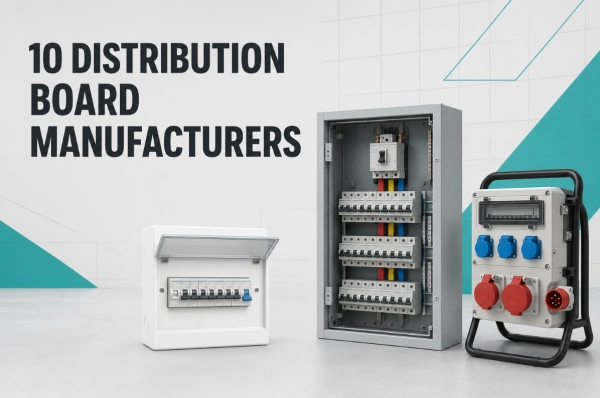
In low-voltage electrical products, terms such as distribution board, panel board, and consumer unit are often used in similar situations. They all relate to circuit distribution and electrical protection, but they are not always used in exactly the same way. The meaning can change depending on the country, project type, product structure, and the buyer’s search habits.
For buyers, the key is not only to remember the words, but to understand what product each term usually points to. A residential buyer may search for a consumer unit, a contractor may ask for a distribution board, and an engineering project may describe the product as a panel board or distribution panel board. If the terminology is not clear, product selection and website keyword planning can easily become confusing.
A broad term for boards that receive power and distribute it to different branch circuits.
Often used in project, commercial, industrial, or engineering contexts for circuit distribution panels.
Usually refers to a compact final distribution board used in residential or small building applications.
Why these terms are often confused
These terms are often confused because they describe products that perform similar basic functions. In most cases, the product receives incoming electrical power, distributes it to outgoing circuits, and houses protective devices such as circuit breakers, isolators, residual current devices, or other low-voltage electrical components.
The confusion usually comes from market language rather than from the basic electrical purpose. Different regions, buyers, engineers, and suppliers may use different names for similar products. A product called a distribution board in one market may be described as a panel board in another. A small residential distribution board may be called a consumer unit, especially when it is designed for final circuit protection in homes or small buildings.
The practical difference is not only the name. Buyers should also check the phase type, number of ways, rated current, enclosure design, protective device layout, and application environment.
| Reason for confusion | What happens in real buying | How to handle it |
|---|---|---|
| Similar function | Different terms may all refer to circuit distribution and protection. | Check the product structure and application, not only the name. |
| Regional wording | Some buyers use “consumer unit,” while others search for “distribution board” or “panel board.” | Use the term that matches the target market and product type. |
| Supplier naming habits | Manufacturers may name products based on catalog systems, not buyer search behavior. | Product pages should combine technical accuracy with common buyer keywords. |
| Project documentation | Engineering documents may use more formal terms such as panel board or distribution panel. | Use project-related terminology when targeting contractors, engineers, or project buyers. |
What a consumer unit usually refers to
A consumer unit usually refers to a compact distribution board used for final circuit protection in residential or small building electrical systems. It is commonly associated with household circuits such as lighting, socket outlets, kitchen circuits, bathroom circuits, air conditioners, water heaters, and other final loads.
Compared with larger distribution boards, a consumer unit is usually more focused on final circuits and daily building use. It may include a main switch, MCBs, RCCBs, RCBOs, neutral terminals, earth terminals, and a protective enclosure. Depending on the market, it may be available in different numbers of ways, surface-mounted or flush-mounted designs, and different cover structures.
Homes, apartments, villas, small offices, shops, and light commercial spaces.
Final circuits for lighting, sockets, appliances, HVAC, and small equipment loads.
Number of ways, protection device compatibility, cover design, wiring space, and installation convenience.
For website content, the term “consumer unit” should be used carefully. It is useful when the product is clearly aimed at household or small building final distribution. If the product is a larger three-phase board or project-type enclosure, “consumer unit” may be too narrow and may not match the buyer’s actual requirement.
When “panel board” is used
“Panel board” is often used in electrical engineering, commercial buildings, industrial projects, and some regional markets. It usually refers to an electrical panel that distributes power to branch circuits and holds switching or protective devices. In many cases, buyers may also use terms such as distribution panel, electrical panel board, distribution panel board, or circuit breaker panel.
Compared with “consumer unit,” the term “panel board” can sound more project-oriented. It is often used when buyers are dealing with commercial buildings, industrial facilities, main distribution systems, sub-distribution systems, or higher-capacity electrical installations.
| Term | Common meaning | Better fit |
|---|---|---|
| Panel board | A board or panel used to distribute electrical circuits. | Commercial, industrial, and project-related electrical pages. |
| Distribution panel board | A more descriptive term combining distribution function and panel structure. | SEO pages targeting buyers who search with both “distribution” and “panel board.” |
| Electrical panel board | A broad phrase for electrical panels used in power distribution or control. | General educational content or product explanation pages. |
| Circuit breaker panel | A panel that houses circuit breakers for branch circuit protection. | Markets where buyers focus more on breakers than on the enclosure itself. |
When using “panel board” on a website, it is better to explain the product clearly with supporting terms such as single phase, three phase, TPN, number of ways, rated current, enclosure material, and installation method. This avoids attracting broad traffic that may not match the actual product.
Which term is better for product pages vs blogs
Product pages and blog pages should not always use keywords in the same way. A product page needs to match the actual product and buyer search intent as accurately as possible. A blog page can explain terminology, compare different names, and cover broader search questions.
For product pages, the main keyword should describe what the buyer can actually purchase. For blog pages, it is acceptable to cover several related terms because the purpose is to educate buyers and guide them toward the correct product category.
| Page type | Recommended keyword direction | Reason |
|---|---|---|
| Category page | Distribution Board | It is broad, clear, and suitable for covering multiple product types under one category. |
| Residential product page | Consumer Unit or Single Phase Distribution Board | These terms better match household and small building final circuit applications. |
| Commercial or project product page | Three Phase Distribution Board, TPN Distribution Board, or Distribution Panel Board | More suitable for buyers looking for higher-capacity or project-based electrical distribution products. |
| Blog or knowledge page | Distribution Board vs Panel Board vs Consumer Unit | Comparison content can cover buyer confusion, regional wording, and related keyword variations naturally. |
• Use “Distribution Board” as the main category term for broad coverage.
• Use “Consumer Unit” only when the product is clearly for residential or small building use.
• Use “Panel Board” or “Distribution Panel Board” for project, commercial, or engineering-related content.
• Use comparison blogs to explain related terms instead of forcing every keyword into one product title.
How buyers should understand these names
Buyers should understand these names as product language, not as the only basis for selection. The name gives a starting point, but the real selection should depend on the electrical system and installation requirement.
Before choosing a distribution board, panel board, or consumer unit, buyers should check whether the product matches the incoming supply, circuit quantity, rated current, protective device layout, enclosure structure, installation method, and local market expectations.
Confirm whether the project is residential or small commercial, and check the required number of ways and protective device arrangement.
Confirm whether they need single-phase, three-phase, TPN, main distribution, or sub-distribution application.
Use it as a broad starting term, then narrow the selection by phase, circuit number, rated current, and installation environment.
In short, distribution board is usually the safest broad term for international product classification. Consumer unit is more specific and often suitable for residential final distribution. Panel board is useful for project, commercial, industrial, or engineering-related wording. Understanding these differences helps buyers communicate more clearly and helps suppliers organize product pages with better keyword accuracy.
M&K supplies distribution board products for different low-voltage electrical applications, including single-phase and three-phase solutions for residential, commercial, and project use. If you have questions about product selection, specifications, or purchasing options, you can contact us for further support.