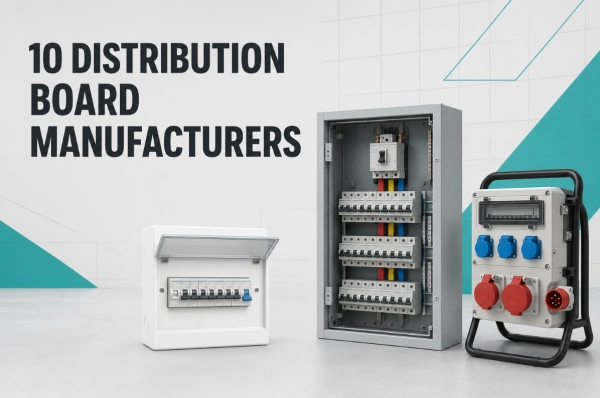
A distribution board is one of the most basic but important parts of a building electrical system. It receives incoming electrical power, divides it into different branch circuits, and helps protect each circuit through devices such as circuit breakers, isolators, residual current devices, or other protective components.
In simple terms, it works like the control point between the main power supply and the final electrical loads. Lighting, sockets, air conditioners, machinery, pumps, office equipment, and other electrical devices usually do not connect directly to the main supply. They are arranged into circuits, and those circuits are managed through a distribution board.
Divides incoming power into multiple circuits for different areas, rooms, floors, or equipment groups.
Works with protective devices to reduce risks caused by overloads, short circuits, leakage faults, or unsafe operation.
Makes it easier to isolate, inspect, maintain, or expand electrical circuits in a more organized way.
What a distribution board does
The basic function of a distribution board is to distribute electricity safely and clearly. After power enters a building or a certain electrical area, it needs to be separated into smaller circuits. Each circuit can then serve a specific load, such as lighting, wall sockets, HVAC equipment, water pumps, kitchen appliances, or production machines.
Without this circuit division, electrical installation would be difficult to control and maintain. A fault in one area could affect more equipment than necessary, and electricians would have fewer safe isolation points for inspection or repair.
A distribution board does not only “hold breakers.” Its real value is that it organizes power supply, protection, control, and maintenance access into one practical electrical enclosure.
In most electrical systems, a distribution board helps with:
• Receiving power from the main supply, transformer, meter box, or upstream panel.
• Dividing power into separate outgoing circuits.
• Housing protective devices such as MCBs, MCCBs, RCCBs, RCBOs, isolators, or surge protection devices.
• Allowing individual circuits to be switched off during inspection, maintenance, or emergency handling.
• Keeping circuit wiring more organized and easier to identify.
Why buildings need circuit distribution
Modern buildings use many electrical loads at the same time. A small apartment, a villa, a commercial shop, an office floor, a factory workshop, and a public facility all have different circuit requirements. Lighting circuits, socket circuits, air-conditioning circuits, machinery circuits, and safety equipment circuits should not be mixed without a clear distribution plan.
Circuit distribution makes the electrical system more manageable. When a problem occurs, only the affected circuit may trip or be isolated, instead of shutting down the entire building. This is especially important in commercial, industrial, and public environments where downtime, safety, and maintenance access matter.
| Need | How a distribution board helps | Typical result |
|---|---|---|
| Separate circuit control | Each outgoing circuit can be protected and operated independently. | Easier troubleshooting and safer maintenance. |
| Load organization | Different electrical loads can be arranged by area, phase, function, or equipment type. | Cleaner wiring and better system planning. |
| Electrical protection | Protective devices can disconnect abnormal circuits when required. | Reduced risk from overload, short circuit, or leakage faults. |
| Future expansion | A suitable board layout can reserve space for additional circuits. | More convenient upgrades when electrical demand increases. |
Where distribution boards are commonly installed
Distribution boards are used in many types of electrical projects. The exact installation position depends on building design, power capacity, wiring route, local electrical standards, and maintenance requirements. In general, they are installed where power needs to be divided into branch circuits and where electricians can access the board safely.
Apartments, villas, houses, and residential complexes use distribution boards for lighting, socket, kitchen, bathroom, and air-conditioning circuits.
Offices, shops, supermarkets, hotels, schools, and hospitals need organized circuit distribution for daily operation and maintenance.
Workshops, warehouses, production areas, and equipment rooms often require stronger boards for machinery, motors, pumps, and auxiliary systems.
Public buildings, utility rooms, communication sites, and service facilities may use distribution boards as part of a wider power distribution network.
For indoor projects, the board may be installed on a wall, recessed into the wall, or placed inside an electrical room. For harsher environments, the enclosure material, protection level, corrosion resistance, and installation method become more important.
Main types of distribution boards
Distribution boards can be grouped in different ways. Buyers may classify them by phase, application, installation method, number of ways, enclosure design, or the protective devices used inside. For basic understanding, the following types are commonly seen in building electrical projects.
| Type | Basic meaning | Common application |
|---|---|---|
| Single phase distribution board | Designed for single-phase power systems, usually used for lower-load applications. | Homes, small shops, apartments, and light commercial spaces. |
| Three phase distribution board | Designed for three-phase systems where higher capacity or balanced load distribution is required. | Factories, workshops, commercial buildings, and larger electrical installations. |
| TPN distribution board | A three phase and neutral board used to distribute three-phase power with neutral connection. | Commercial and industrial projects with mixed single-phase and three-phase loads. |
| Consumer unit | A compact distribution board commonly used in residential and small building systems. | Household and small commercial final circuit protection. |
| Main distribution board | A higher-level board that receives power from the main source and feeds sub-distribution boards. | Larger buildings, electrical rooms, industrial sites, and multi-level power distribution systems. |
The correct type should be selected according to the incoming supply, rated current, number of outgoing circuits, installation environment, wiring method, and required protection devices. For B2B purchasing, buyers also need to check enclosure structure, material thickness, surface treatment, busbar arrangement, neutral and earth terminals, and compatibility with local market requirements.
How this product fits into electrical systems
A distribution board is not usually an isolated product. It is part of the wider low-voltage electrical distribution system. Power may come from a transformer, generator, meter box, switchgear, or main panel. The distribution board then sends that power to final circuits or sub-circuits in a controlled structure.
• Power source or incoming supply
• Main switch, meter, or upstream protection
• Main distribution board or sub-distribution board
• Circuit breakers and protective devices
• Final loads such as lights, sockets, motors, appliances, or equipment
In a small building, one distribution board may be enough to manage the main circuits. In a larger project, several boards may be used at different levels. For example, a main distribution board may feed several floor distribution boards, and each floor board may feed lighting, socket, HVAC, and special equipment circuits.
This is why distribution board selection should not only focus on appearance or the number of ways. A reliable board should match the actual electrical design, provide enough space for wiring and protection devices, support safe installation, and make future maintenance easier.
The board should be practical to install, easy to wire, and suitable for the required protective devices and circuit layout.
Product range, common market sizes, stable quality, packaging, and repeat supply are important for stock planning.
The board should match project standards, safety requirements, installation environment, and long-term maintenance needs.
To summarize, a distribution board is the basic node where electrical power becomes organized, protected, and usable for different circuits. It supports safety, reliability, maintenance, and future expansion in residential, commercial, and industrial electrical systems.
M&K supplies distribution board products for different low-voltage electrical applications, including single-phase and three-phase solutions for residential, commercial, and project use. If you have questions about product selection, specifications, or purchasing options, you can contact us for further support.