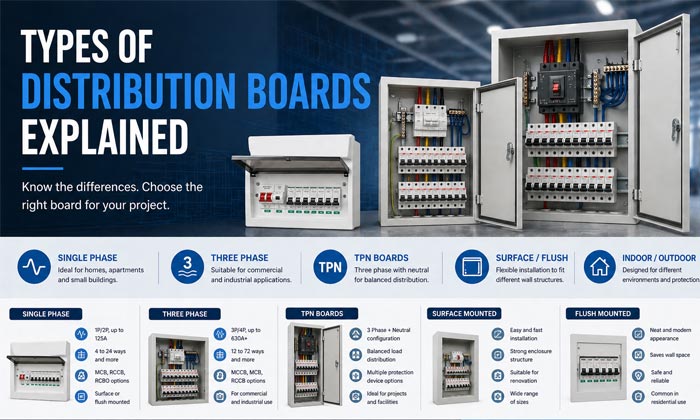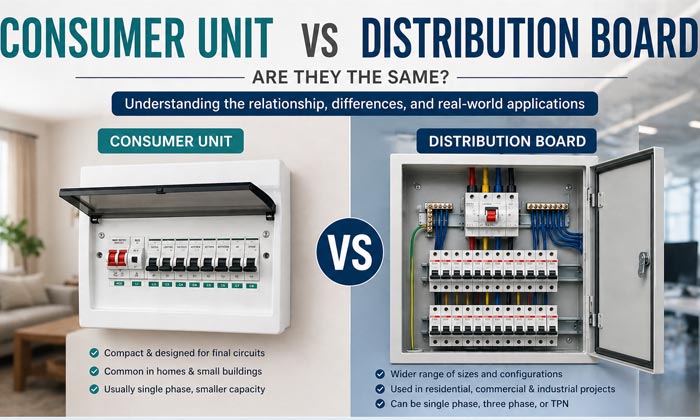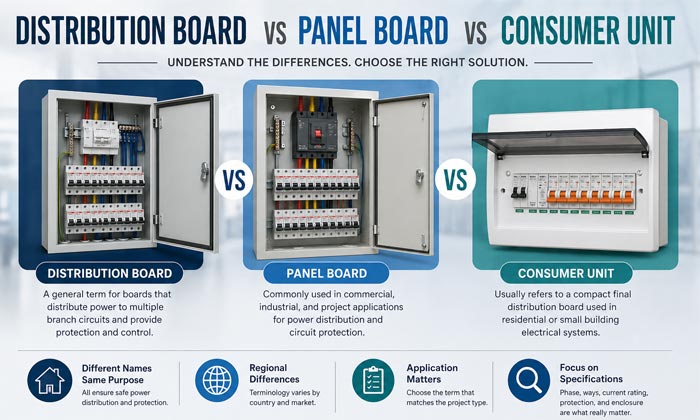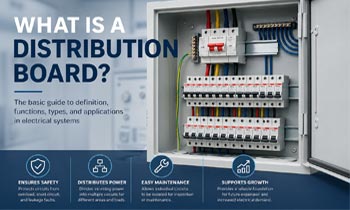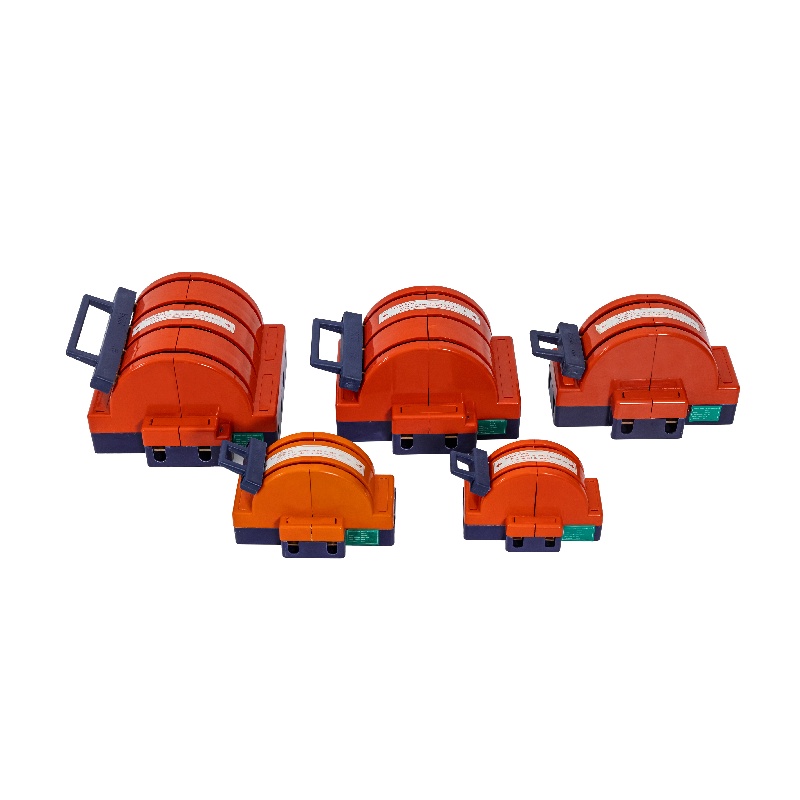
In an electrical system, a distribution board works as the point where incoming power is received, divided, protected, and sent to different circuits. It does not generate electricity by itself. Its main role is to make power delivery safer, clearer, and easier to control after electricity enters a building, floor, room, workshop, or equipment area.
For practical use, a distribution board connects the upstream power supply with the downstream electrical loads. These loads may include lighting, sockets, air conditioners, pumps, machinery, office equipment, kitchen appliances, or other devices. By arranging them into branch circuits, the electrical system becomes easier to operate, inspect, maintain, and expand.
Receives incoming electricity and sends it to different outgoing circuits according to the system design.
Separates lighting, sockets, equipment, HVAC, and other loads into manageable electrical branches.
Houses protective devices that help disconnect abnormal circuits during overload, short circuit, or leakage faults.
Incoming power and outgoing circuits
The first role of a distribution board is to handle the relationship between incoming power and outgoing circuits. Incoming power usually comes from an upstream source such as a main switch, meter box, transformer, generator, main distribution panel, or sub-main cable. After entering the distribution board, this power is divided into several outgoing circuits.
Each outgoing circuit serves a defined electrical purpose. For example, one circuit may supply room lighting, another may supply wall sockets, and another may supply an air-conditioning unit or machine. This arrangement avoids having all electrical loads connected in one uncontrolled line.
A distribution board makes electrical power usable by dividing one incoming supply into multiple controlled circuits. This is the core reason it is used in residential, commercial, and industrial electrical systems.
| Power stage | What happens | Why it matters |
|---|---|---|
| Incoming supply | Power enters the board from an upstream electrical source. | Provides the main energy source for downstream circuits. |
| Main control | A main switch, isolator, or main breaker may control the board supply. | Allows the board or section to be isolated when needed. |
| Circuit division | Power is distributed to different outgoing ways or branch circuits. | Keeps electrical loads separated and easier to manage. |
| Final loads | Outgoing circuits supply lights, sockets, appliances, motors, or equipment. | Delivers power to the actual points of use in the building. |
How branch circuits are organized
Branch circuits are organized based on how electricity is used in the building. A good distribution board layout should make the system clear for installation, daily use, inspection, and future maintenance. Instead of mixing all electrical loads together, circuits are usually separated by function, location, load size, or safety requirement.
For example, lighting circuits are often separated from socket circuits because their load behavior and protection requirements are different. Air conditioners, water heaters, pumps, and machines may need dedicated circuits because they draw higher current or require more specific protection.
Lighting, sockets, HVAC, machinery, pumps, and special equipment can be arranged as separate circuits.
Different rooms, floors, workshops, or zones can have independent circuit groups for easier control.
High-load equipment can be separated from smaller general-use circuits to support safer operation.
Some circuits may require leakage protection, surge protection, or more specific circuit breaker selection.
Clear branch circuit organization also helps electricians identify problems faster. If one circuit trips, the user can usually locate the affected area or equipment more quickly. This reduces unnecessary shutdowns and makes the electrical system more practical for long-term use.
Why protective devices matter
A distribution board is closely connected with electrical protection. The board itself provides the enclosure and circuit arrangement, while protective devices inside the board help respond to abnormal electrical conditions. These devices may include miniature circuit breakers, molded case circuit breakers, residual current devices, residual current circuit breakers with overcurrent protection, isolators, surge protection devices, or other components depending on the project.
When a circuit experiences overload, short circuit, leakage current, or surge risk, the correct protective device can help disconnect or limit the problem. This is why distribution board design should consider not only the number of ways, but also the type and arrangement of protective devices.
| Protection concern | Common risk | How the board supports protection |
|---|---|---|
| Overload | Too much current flows through a circuit for a period of time. | Circuit breakers can be installed to disconnect overloaded circuits. |
| Short circuit | A fault creates a very high current path. | Protective devices can interrupt the faulty circuit quickly. |
| Leakage current | Current may flow through an unintended path, creating safety hazards. | RCD, RCCB, or RCBO devices can be used where leakage protection is required. |
| Surge voltage | Transient overvoltage may damage sensitive electrical equipment. | Surge protection devices can be arranged inside or near the distribution board. |
Protective device selection should follow the electrical design, local regulations, load type, rated current, breaking capacity, leakage protection requirement, and installation environment. A good distribution board provides enough space and structure for these devices to be installed and wired properly.
Why enclosure structure matters
The enclosure is more than a metal or plastic box around the devices. It affects installation quality, wiring space, protection level, heat dissipation, maintenance access, and long-term durability. In many projects, the enclosure structure directly influences whether the distribution board is convenient and reliable to use.
A practical distribution board should have a clear internal layout, sufficient cable entry space, stable mounting points, proper door structure, reliable neutral and earth terminal arrangement, and suitable surface treatment. For three-phase boards or project-type boards, busbar design and internal clearance are also important.
• Enclosure material and surface treatment
• Board size, number of ways, and internal wiring space
• Door design, lock, cover, and access convenience
• DIN rail, busbar, neutral bar, and earth bar arrangement
• Cable entry position and installation method
• Suitability for indoor, commercial, project, or industrial environments
For B2B purchasing, enclosure consistency is especially important. Wholesalers, contractors, and project buyers often need products that are easy to install repeatedly, stable in structure, and suitable for the target market’s common electrical accessories and wiring practices.
Distribution board and daily electrical safety
In daily use, a distribution board helps make the electrical system safer and easier to manage. When circuits are clearly divided and properly protected, users can reduce the risk of overloaded wiring, unclear fault locations, unsafe maintenance, or unnecessary shutdown of unrelated circuits.
For example, if a socket circuit has a fault, a properly arranged board allows that circuit to be isolated without cutting power to every lighting circuit. In a commercial or industrial environment, this kind of circuit separation can reduce downtime and help maintenance teams work more efficiently.
Users can identify and control different circuits more clearly, especially when switches and labels are arranged properly.
Electricians can isolate affected circuits, inspect wiring, replace devices, or expand circuits with better access and organization.
A suitable board layout supports future electrical upgrades, additional circuits, and safer system management over time.
A distribution board therefore plays a practical role in power routing, branch circuit organization, protection device installation, enclosure safety, and daily electrical management. It is one of the basic products that helps turn electrical design into a usable and maintainable system.
M&K supplies distribution board products for different low-voltage electrical applications, including single-phase and three-phase solutions for residential, commercial, and project use. If you have questions about specifications, product selection, or purchasing options, you can contact us for further support.