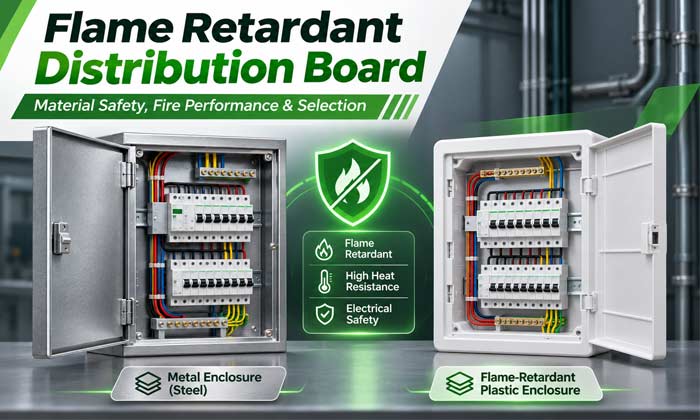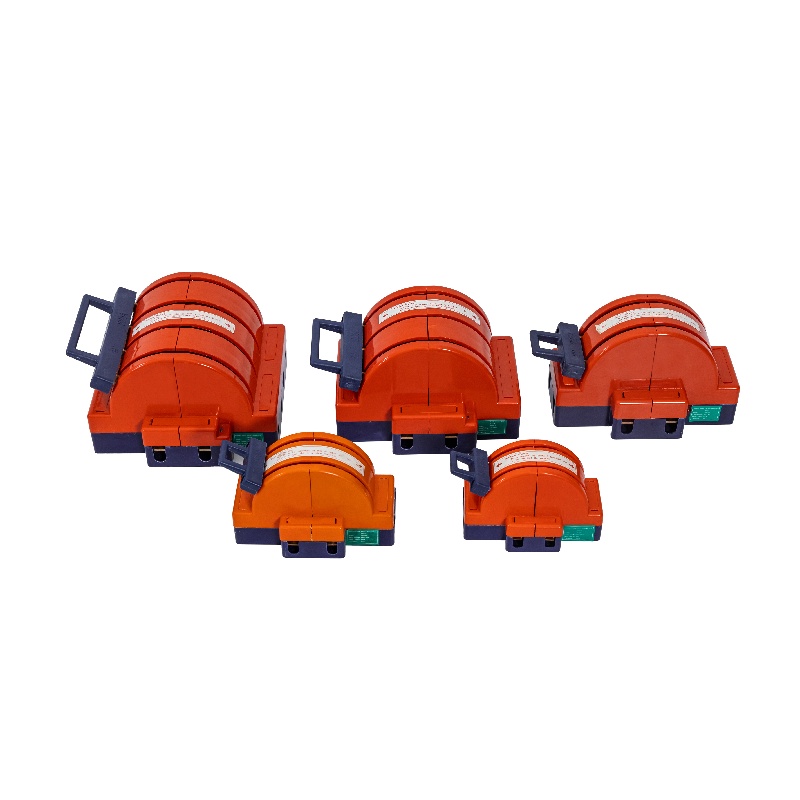
A flame-retardant distribution board uses tested materials that resist ignition or slow flame spread, helping reduce fire risks from abnormal heat or electrical faults.
A distribution board houses circuit breakers, busbars, and other protective devices that distribute electrical power across multiple circuits. During operation, loose connections, overloading, and electrical faults can generate excessive heat, potentially affecting nearby insulating materials and enclosure components.
For this reason, material selection is an important part of distribution board safety. Flame-retardant plastics and non-combustible metal enclosures offer different approaches to managing fire-related risks. Understanding their properties, testing requirements, and application limits helps ensure that the selected distribution board meets the safety requirements of its installation.
What Is a Flame-Retardant Distribution Board?
A flame-retardant distribution board is an electrical distribution assembly that uses materials designed and tested to resist ignition or slow the spread of flames when exposed to abnormal heat or fire conditions.
In plastic distribution boards, flame retardancy is generally achieved by using specially formulated thermoplastics containing flame-retardant additives. These materials are designed to improve resistance to combustion compared with standard plastic grades.
Common materials used in electrical enclosures and components include:
- Flame-Retardant ABS: Modified ABS materials offer improved flame performance while retaining useful properties such as impact resistance, lightweight construction, and electrical insulation.
- Flame-Retardant Polycarbonate (PC): Certain PC grades provide a combination of impact strength, dimensional stability, and improved resistance to ignition.
- Flame-Retardant PC/ABS: This material combines selected properties of polycarbonate and ABS, offering a balance of mechanical performance and flame resistance.
- Metal Enclosures: Steel and other suitable metals are non-combustible enclosure options and do not require plastic flame-retardant additives to achieve that material characteristic.
It is important to distinguish flame-retardant materials from ordinary plastics. Standard ABS and flame-retardant ABS may have different fire-performance characteristics, even when their appearance is similar. The actual performance depends on the material formulation, thickness, product construction, and relevant test results.
How Do Flame-Retardant Materials Work?
Flame-retardant additives can work through different physical and chemical mechanisms. Depending on the formulation, they may:
- Form a Protective Layer: Some materials create a carbon-rich protective layer when exposed to heat, helping reduce heat transfer and limit the supply of combustible gases.
- Absorb Heat: Certain additives undergo endothermic reactions that absorb heat and slow the temperature increase in the surrounding material.
- Interrupt Combustion Reactions: Some flame-retardant compounds interfere with chemical reactions involved in flame propagation.
Not every flame-retardant material uses all these mechanisms. Their effectiveness depends on the specific formulation and the conditions under which the material is tested.
Flame retardancy also does not mean that a material is completely fireproof, produces no smoke, or remains structurally intact under every fire condition. These properties require separate evaluation.
Does a Distribution Board Need Flame-Retardant Material?
Yes, insulating materials used in distribution boards must meet the applicable requirements for resistance to abnormal heat and fire caused by internal electrical effects. However, the exact material requirements depend on the assembly design, product category, installation environment, and applicable electrical standards.
During normal operation, electrical components generate heat. Under abnormal conditions such as loose connections, overloading, or short circuits, temperatures can rise significantly. If insulating materials cannot withstand these conditions, they may soften, deform, ignite, or lose their ability to support and protect electrical components.
Flame-retardant properties are therefore particularly important for insulating parts that support current-carrying components or may be exposed to abnormal thermal stress.
Relevant Electrical Standards
The IEC 61439 series provides requirements for low-voltage switchgear and controlgear assemblies, including distribution boards. Its requirements address construction, performance, and design verification.
For example, IEC 61439-3:2024 covers distribution boards intended to be operated by ordinary persons, including certain domestic and similar applications. The standard works alongside the applicable general requirements of IEC 61439-1.
Resistance of insulating materials to abnormal heat and fire due to internal electrical effects can be verified through glow-wire testing in accordance with the relevant IEC 60695 test methods.
When selecting a distribution board, buyers should check the applicable standard and supporting test documentation rather than relying solely on a general flame-retardant label.
For reference:
- IEC 61439-3:2024 – Distribution Boards Intended to Be Operated by Ordinary Persons
- ABB – The Standard IEC 61439 in Practice
Why Is Flame-Retardant Material Important in Distribution Boards?
Flame-retardant materials contribute to electrical fire safety by reducing the likelihood of ignition and slowing flame propagation under specified test conditions. Their importance extends beyond the enclosure itself because insulating components also help maintain the structural and electrical integrity of the assembly.
1. Reducing the Risk of Fire Spread
Electrical faults can produce localized heat, sparks, or hot components. If surrounding plastic materials ignite easily, combustion may spread to other enclosure parts or nearby materials.
Flame-retardant materials are designed to resist ignition or limit continued burning under specified conditions. This helps reduce the contribution of enclosure materials to fire development, although it cannot eliminate the risk of an electrical fire.
2. Protecting Internal Electrical Components
Distribution boards contain circuit breakers, terminals, busbars, and insulating supports. Some of these components are exposed to heat generated during normal operation or abnormal electrical conditions.
Materials with suitable thermal and flame-retardant properties help maintain the required physical characteristics under specified test conditions. This is particularly important for parts that support live components or provide electrical insulation.
3. Supporting Overall Electrical Safety
Material performance is one part of a distribution board’s overall safety design. Suitable insulating materials, correctly selected protective devices, proper wiring, and secure electrical connections work together to reduce electrical hazards.
For example, a flame-retardant enclosure cannot compensate for an incorrectly rated circuit breaker or a loose terminal connection. Both material selection and electrical design must meet the requirements of the installation.
4. Meeting Project and Regulatory Requirements
Many electrical projects require distribution boards to comply with specific product standards and material performance requirements. Contractors, engineers, and procurement teams may need to verify test reports and conformity documentation before approving equipment.
Selecting materials with documented fire-performance characteristics helps support product evaluation, project approval, and compliance with applicable electrical regulations.
5. Considering Smoke and Environmental Performance
Fire safety involves more than whether a material ignites or continues burning. Smoke generation, combustion by-products, and the chemical composition of flame-retardant additives may also be relevant to product selection.
Different flame-retardant chemicals have different properties, and their environmental and health profiles are not identical. The National Institute of Environmental Health Sciences (NIEHS) provides further information about flame-retardant chemicals and potential exposure concerns.
For projects with specific environmental or restricted-substance requirements, buyers should request relevant material declarations and compliance documentation from the supplier.
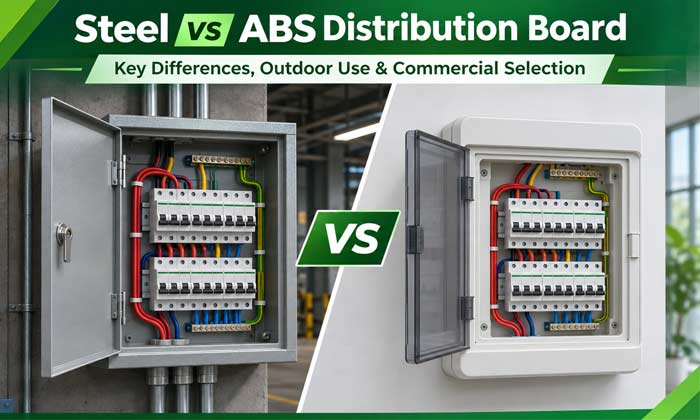
Metal or Flame-Retardant Plastic Distribution Board: Which Is Safer?
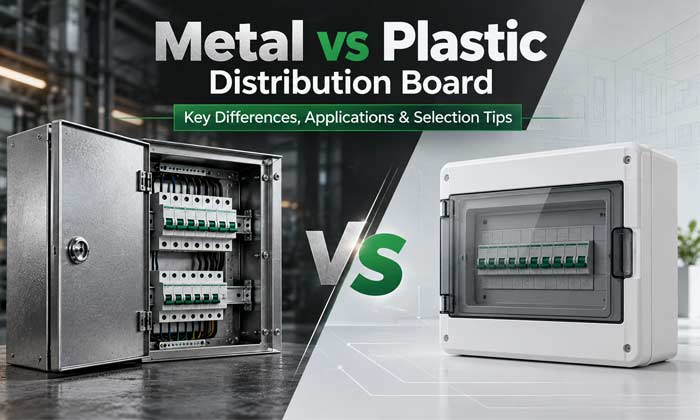
Both metal and flame-retardant plastic distribution boards can provide suitable electrical protection when properly designed and manufactured. Metal offers a non-combustible enclosure, while flame-retardant plastic provides improved resistance to ignition compared with standard plastic grades.
Neither material is universally safer. The decision depends on the installation environment, mechanical protection requirements, electrical design, and verified fire-performance characteristics.
Metal Distribution Boards
Metal distribution boards commonly use galvanized steel, stainless steel, or other suitable metals. Their non-combustible construction makes them an option for installations where enclosure material fire performance and mechanical strength are important.
Key characteristics include:
- Non-Combustible Construction: Metal does not burn like conventional plastic materials and does not contribute combustible material to a fire.
- Mechanical Protection: Metal enclosures generally provide good resistance to impact, deformation, and physical damage.
- Heat Transfer: Metal conducts heat more readily than plastic, although actual enclosure temperature depends on the complete assembly design and operating conditions.
- Electrical Bonding: Conductive metal enclosures require appropriate protective earthing and bonding to address electrical fault hazards.
- Corrosion Considerations: Steel requires suitable surface protection or corrosion-resistant construction when exposed to moisture, salt, or chemicals.
Flame-Retardant Plastic Distribution Boards
Flame-retardant plastic distribution boards use specially formulated insulating materials to improve resistance to ignition and flame propagation. They are often selected where lightweight construction and electrical insulation are important.
Key characteristics include:
- Improved Flame Performance: Suitable flame-retardant grades can resist ignition and limit continued burning under specified test conditions.
- Electrical Insulation: Plastic enclosures provide an insulating external surface, although the complete electrical installation must still meet applicable protective earthing requirements.
- Corrosion Resistance: Plastic does not rust, making it useful in environments where metal corrosion is a concern.
- Lightweight Construction: Plastic enclosures are generally easier to transport and install than comparable metal enclosures.
- Material Limitations: Plastic may soften, deform, or deteriorate under excessive heat, depending on its formulation and operating conditions.
Metal vs Flame-Retardant Plastic: Quick Comparison
| Comparison | Metal Distribution Board | Flame-Retardant Plastic Distribution Board |
|---|---|---|
| Fire Performance | Non-combustible enclosure material | Designed to resist ignition or slow flame propagation |
| Heat Resistance | Does not melt or burn like plastic, but can become hot | Depends on the polymer grade and thermal specifications |
| Smoke Generation | The metal enclosure itself does not produce combustible smoke | Depends on the polymer and flame-retardant formulation |
| Mechanical Strength | Generally offers higher rigidity and impact resistance | Depends on material grade, thickness, and design |
| Electrical Properties | Conductive and requires appropriate earthing and bonding | Insulating enclosure material |
| Corrosion Resistance | Depends on metal type and protective finish | Does not rust; chemical resistance varies |
| Weight | Generally heavier | Generally lighter |
| Typical Applications | Industrial facilities, commercial buildings, and installations requiring robust enclosures | Residential buildings, offices, and suitable light commercial applications |
Which Material Should You Choose?
A metal distribution board may be more suitable when the project requires a non-combustible enclosure, strong mechanical protection, or specific structural characteristics.
A flame-retardant plastic distribution board may be more practical when lightweight construction, electrical insulation, and corrosion resistance are priorities, provided its tested fire and temperature performance meets the project requirements.
For both options, the complete assembly must be evaluated. An enclosure material’s flame-retardant rating alone does not demonstrate that the distribution board can contain an internal electrical arc or prevent every type of electrical fire.
How to Check Flame-Retardant Performance in a Distribution Board?
When purchasing a flame-retardant distribution board, it is important to verify the actual material performance rather than relying only on product descriptions. The following points can help engineers, contractors, and procurement teams evaluate product suitability.
1. Confirm the Material Grade
Ask whether the enclosure uses standard ABS, flame-retardant ABS, polycarbonate, or another engineering plastic. Different grades can have significantly different resistance to heat and flame.
2. Review Relevant Test Reports
Request documentation showing the applicable flame-retardant or abnormal-heat test methods, test conditions, and results. Glow-wire testing under the relevant IEC 60695 methods is one important consideration for insulating materials used in electrical assemblies.
3. Check the Actual Product Thickness
Material test results can depend on specimen thickness. A test result obtained from a thicker sample should not automatically be assumed to apply to a thinner enclosure wall or component.
4. Verify the Complete Assembly
Check the distribution board’s electrical ratings, temperature-rise performance, mechanical protection, and relevant conformity documentation. Material certification alone does not establish the performance of the complete assembly.
5. Consider the Installation Environment
In addition to flame performance, evaluate operating temperature, moisture, UV exposure, chemical contact, and mechanical impact. The selected enclosure must meet all relevant environmental and electrical requirements.
For project procurement, providing the supplier with the intended application, electrical specifications, installation conditions, and applicable standards can help identify a suitable distribution board configuration.
Need Help Choosing a Flame-Retardant Distribution Board?
Choosing a distribution board involves more than selecting a flame-retardant material. Electrical ratings, enclosure construction, material properties, and applicable safety standards all influence the suitability of the final product.
M&K provides distribution board options for different electrical installation requirements. If you have questions about enclosure materials, flame-retardant specifications, product configurations, or sourcing requirements, contact our team to discuss your needs.