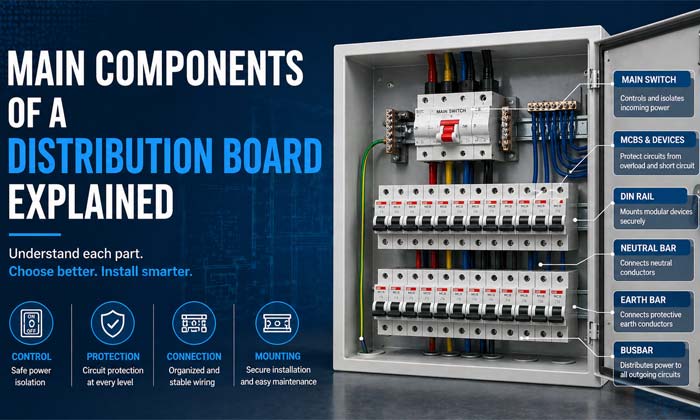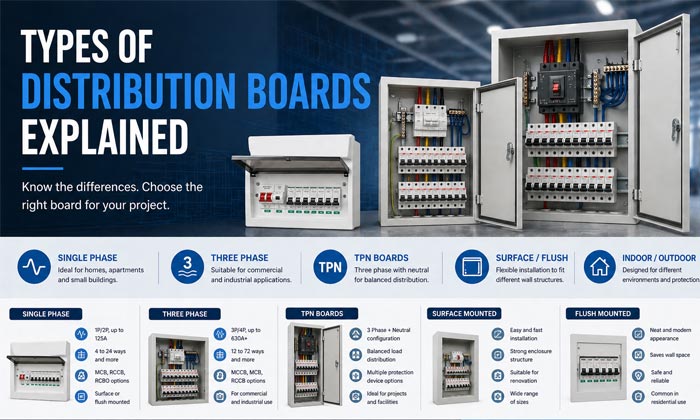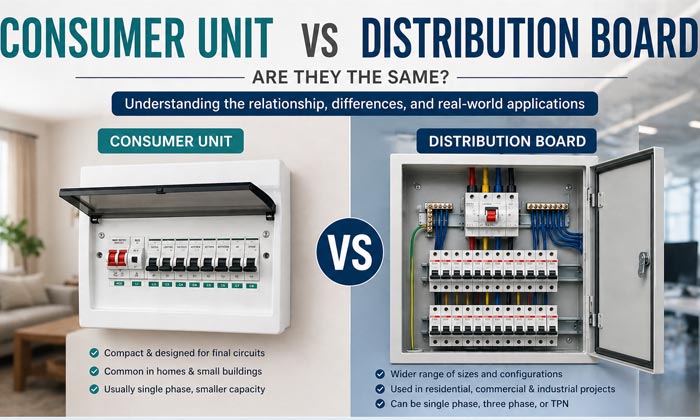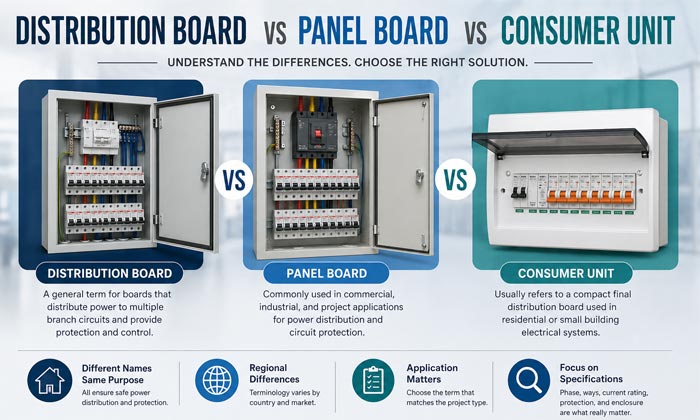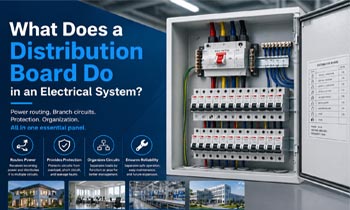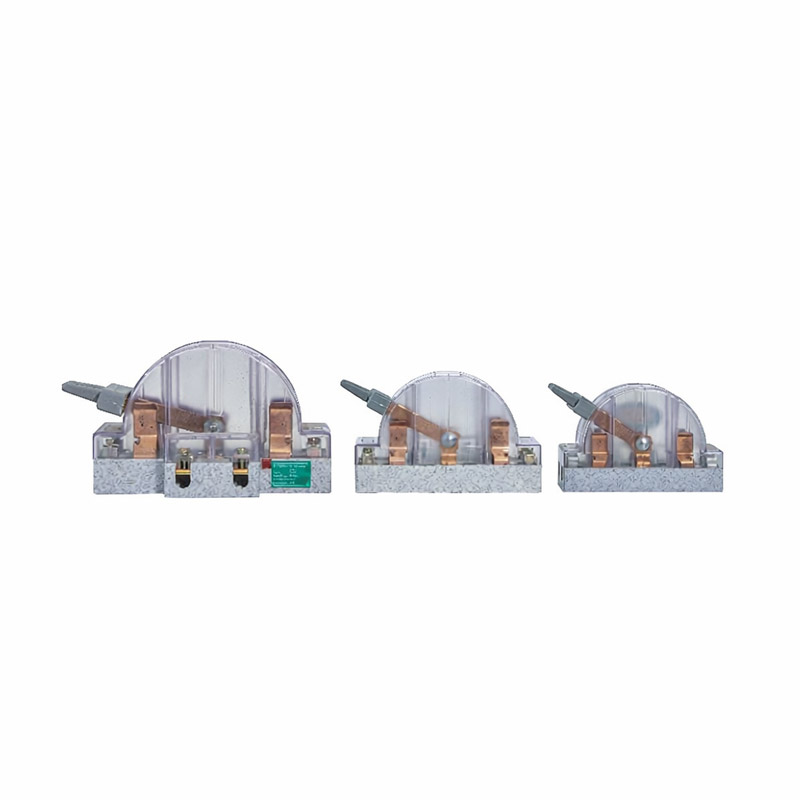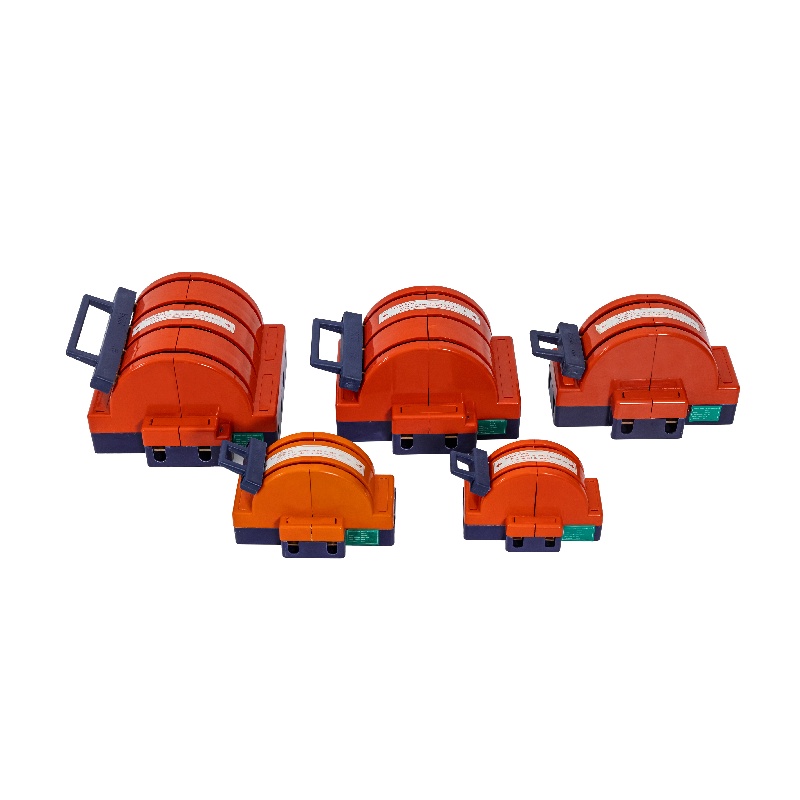
A distribution board is not only an empty enclosure with several circuit breakers inside. Its performance depends on how the main switch, protective devices, busbar, DIN rail, neutral bar, earth bar, terminals, wiring space, and enclosure structure work together. When these components are arranged properly, the board becomes easier to install, safer to operate, and more convenient to maintain.
For buyers, understanding the main components helps avoid a common mistake: judging a distribution board only by its outer size or number of ways. Two boards may look similar from the outside, but the internal layout, device compatibility, wiring space, and terminal arrangement can make a big difference during real installation.
The main switch or incoming device controls the power entering the board.
MCBs, RCCBs, RCBOs, MCCBs, or other devices help protect different circuits.
Busbars, neutral bars, earth bars, and terminals help organize internal electrical connections.
DIN rail, base plate, cover, and enclosure structure affect installation and maintenance.
Main switch and incoming device
The main switch or incoming device is usually the first control point inside the distribution board. It receives power from the upstream supply and allows the board, or a section of the board, to be isolated when necessary. In smaller boards, this may be a main switch or isolator. In larger boards, the incoming device may be a breaker or another suitable protective and switching device.
Its role is practical: when installation, inspection, repair, or emergency handling is required, electricians need a clear way to disconnect the incoming supply. A board without a clear incoming control point can be more difficult and less safe to manage.
The incoming device should match the board design, rated current, phase type, wiring method, and project requirement. It is not simply a switch placed at the top of the board.
| Component | Basic role | Buyer should check |
|---|---|---|
| Main switch | Controls the incoming power supply to the board. | Rated current, pole configuration, installation space, and wiring access. |
| Isolator | Provides an isolation point for maintenance or inspection. | Compatibility with the board layout and required isolation method. |
| Incoming breaker | Can provide incoming control and certain protection functions, depending on design. | Breaking capacity, rated current, wiring space, and project specification. |
MCBs and protective devices
Protective devices are the components most buyers notice first. They are installed to protect circuits and support safer operation when abnormal electrical conditions occur. The most common devices include MCBs, MCCBs, RCCBs, RCBOs, isolators, and surge protection devices, depending on the board type and project requirement.
An MCB is often used for branch circuit protection against overload and short circuit. RCCBs are used for residual current protection. RCBOs combine overcurrent and residual current protection in one device. MCCBs may be used where higher current ratings or larger project requirements are involved. Surge protection devices can be included when transient overvoltage protection is required.
| Device | What it usually does | Where it is commonly used |
|---|---|---|
| MCB | Protects branch circuits from overload and short circuit conditions. | Lighting, socket, appliance, and general final circuits. |
| RCCB / RCD | Provides residual current protection where leakage current risk must be controlled. | Residential, commercial, bathroom, outdoor, and higher-safety circuits. |
| RCBO | Combines overcurrent and residual current protection for an individual circuit. | Circuits that require more complete individual protection. |
| MCCB | Used for higher current protection and larger distribution applications. | Three phase, commercial, industrial, and project distribution boards. |
| SPD | Helps protect equipment from surge voltage and transient overvoltage events. | Buildings with sensitive equipment or surge protection requirements. |
For procurement, the board should have enough space and the correct structure to install these devices neatly. If the internal layout is too tight, installation becomes difficult, wiring may be crowded, and later maintenance can become inconvenient.
DIN rail and component mounting
The DIN rail is the mounting structure used to hold modular devices such as MCBs, RCCBs, RCBOs, isolators, timers, contactors, surge protection devices, and other accessories. It looks simple, but it affects whether devices are aligned, secure, easy to install, and convenient to replace.
A good DIN rail arrangement should allow devices to sit firmly and leave enough space for wiring. In a distribution board, the rail position should also match the cover opening, device height, busbar position, and incoming/outgoing cable route. If the rail is poorly positioned, even standard devices can be difficult to install neatly.
The DIN rail helps protective devices line up correctly behind the cover opening.
A firm rail structure keeps devices stable during installation, wiring, and long-term use.
When devices are mounted clearly, electricians can replace or inspect them more efficiently.
For wholesalers and contractors, this detail matters because repeated installation should be predictable. A board that accepts standard modular devices smoothly can reduce installation frustration and improve site efficiency.
Neutral bar and earth bar
The neutral bar and earth bar are important internal connection points in a distribution board. They help organize neutral conductors and protective earth conductors from different circuits. Although they are not as visible as circuit breakers, they strongly affect wiring clarity, safety, and maintenance.
A neutral bar provides connection points for neutral wires. An earth bar provides connection points for protective earth wires. In many installations, clear separation and accessible terminal positions are important because electricians need to identify, connect, test, and maintain circuits correctly.
| Part | Main purpose | Why layout matters |
|---|---|---|
| Neutral bar | Collects and organizes neutral conductors from circuits. | A clear position reduces wiring confusion and supports easier inspection. |
| Earth bar | Connects protective earth conductors for circuit safety. | Accessible terminals help electricians connect and verify grounding properly. |
• Number of terminal points and whether they match the circuit quantity
• Terminal accessibility after devices are installed
• Clear separation of neutral and earth connections
• Screw quality, conductor holding strength, and installation convenience
• Compatibility with the wiring practices of the target market
Busbar and internal power distribution
The busbar is used to distribute electrical power inside the board. In many distribution boards, a busbar helps connect the incoming supply to multiple protective devices or outgoing circuits in a more organized way. In single phase boards, the busbar arrangement may be simple. In three phase or TPN boards, the busbar structure becomes more important because phase arrangement and current capacity must be considered.
A suitable busbar design can make internal distribution cleaner and reduce the need for messy jumper wiring. It also helps improve installation consistency, especially when the same board model is used repeatedly in projects or stock supply.
Busbar design mainly supports clear connection to multiple final circuit protective devices.
Busbar layout should match phase distribution, outgoing ways, rated current, and device arrangement.
The busbar and neutral arrangement should support mixed single phase and three phase load distribution.
Buyers should check the busbar rating, material, spacing, phase arrangement, terminal connection, and whether the design matches the protective devices used in the target electrical system.
Why internal layout affects usability
The internal layout of a distribution board directly affects installation, wiring, troubleshooting, inspection, and future expansion. A board may have the right number of ways, but if the wiring space is too limited or the terminals are poorly positioned, electricians may still find it difficult to use on site.
Good layout means each part has a logical position: incoming device, protective devices, busbar, neutral bar, earth bar, cable entry, and outgoing wiring space should work together. This helps make the board cleaner, easier to understand, and more practical for long-term maintenance.
| Layout factor | What it affects | Why buyers should care |
|---|---|---|
| Wiring space | Cable bending, routing, and termination convenience. | Crowded wiring makes installation slower and maintenance harder. |
| Device spacing | Device installation, heat dissipation, and access. | Proper spacing helps improve usability and service access. |
| Terminal position | Neutral, earth, incoming, and outgoing conductor connection. | Clear terminals reduce wiring mistakes and improve inspection efficiency. |
| Cover and access design | Daily operation, labeling, protection, and maintenance access. | A practical cover design makes the board easier and safer to use. |
• Is there enough space for incoming and outgoing cables?
• Can common protective devices be installed without layout conflict?
• Are neutral and earth terminals easy to access?
• Is the busbar arrangement suitable for the phase and circuit design?
• Does the cover allow clear operation, labeling, and inspection?
• Is the enclosure structure strong enough for the intended installation environment?
In short, the main components of a distribution board are not separate details. The main switch, protective devices, DIN rail, busbar, neutral bar, earth bar, terminals, and enclosure layout all work together. A well-designed board should make power distribution clearer, protection device installation easier, and long-term maintenance more practical.
M&K supplies distribution board products for different low-voltage electrical applications, including single-phase, three-phase, and TPN solutions for residential, commercial, and project use. If you have questions about specifications, internal layout, product selection, or purchasing options, you can contact us for further support.