Table of Contents
What Is a Plastic Distribution Board?
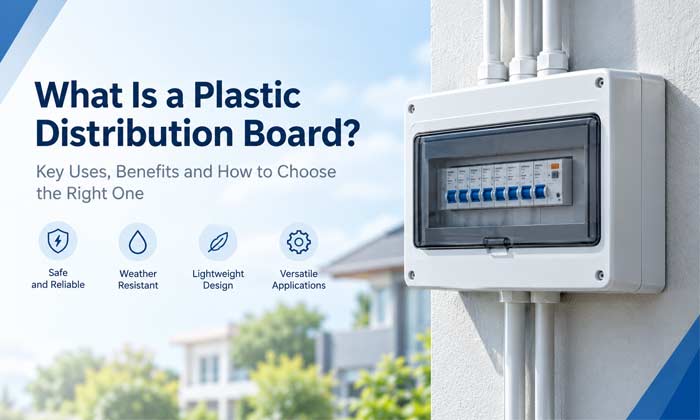
A plastic distribution board is a non-metallic enclosure that houses protective devices and distributes electrical power to multiple circuits.
Also known as a plastic distribution box or plastic consumer unit in certain markets, a Plastic Distribution Board provides a dedicated space for components such as miniature circuit breakers (MCBs), residual current devices (RCDs), and other protective equipment. It helps organize electrical connections and protects internal components from external contact and environmental exposure.
Plastic distribution boards are commonly manufactured from engineering thermoplastics such as ABS (acrylonitrile butadiene styrene) and polycarbonate (PC). These materials offer low weight, electrical insulation, and resistance to corrosion. Depending on the product design, additional features may include flame-retardant properties, UV resistance, impact resistance, and protection against dust or water.
However, these properties vary by material and product specification. A plastic enclosure is not automatically waterproof, fireproof, or suitable for every electrical installation. The complete board must meet the electrical and environmental requirements of its intended application.
Where Is a Plastic Distribution Board Used?
Plastic distribution boards are suitable for many residential, commercial, and specialized installations where a lightweight, corrosion-resistant enclosure is beneficial.
- Residential buildings: Houses and apartments may use plastic distribution boards for lighting, socket outlets, and other domestic circuits, provided the product complies with local requirements.
- Commercial premises: Offices, shops, and small commercial facilities may use plastic enclosures for suitable lighting, socket, and auxiliary circuits.
- Outdoor installations: Garden buildings, outdoor service areas, and similar locations can use plastic distribution boards specifically rated for outdoor exposure and the expected weather conditions.
- Humid and coastal environments: Plastic enclosures resist rust, making appropriately specified products useful in locations exposed to humidity or salt-laden air.
- Agricultural and light industrial applications: Farms, workshops, and certain production areas may benefit from plastic enclosures when the material, impact resistance, temperature rating, and ingress protection meet site requirements.
For outdoor, agricultural, or industrial applications, consider the actual environmental hazards before selecting an enclosure. UV exposure, chemicals, mechanical impacts, and temperature extremes can affect plastic materials differently. The product must be specifically suitable for its intended installation conditions.
When Should You Use a Plastic Distribution Board?
A plastic distribution board is a practical option when low weight, corrosion resistance, electrical insulation, and installation cost are important considerations. It can be particularly suitable for residential installations, light commercial applications, and environments where rust is a concern.
The main advantages include:
- Lightweight construction: Plastic enclosures are generally easier to handle, transport, and mount than comparable metal enclosures.
- Corrosion resistance: Plastic does not rust, which can reduce enclosure maintenance in humid or coastal environments.
- Electrical insulation: The insulating enclosure material does not conduct electricity like metal, although the complete installation must still meet all applicable earthing and protective requirements.
- Cost-effective installation: Depending on the specification and quantity, plastic distribution boards can offer an economical option for standard electrical projects.
There are also limitations to consider. Some plastic enclosures provide less impact resistance and thermal stability than steel alternatives. Their performance under fire conditions depends on the material formulation and verified product characteristics. High ambient temperatures, direct sunlight, chemical exposure, and heavy mechanical stress may limit suitability.
The following comparison summarizes the main differences between plastic and metal distribution boards:
| Factor | Plastic Distribution Board | Metal Distribution Board |
|---|---|---|
| Weight | Generally lightweight and easy to handle. | Generally heavier and more rigid. |
| Corrosion resistance | Does not rust; chemical resistance depends on the polymer. | May require protective coatings or corrosion-resistant metals. |
| Mechanical protection | Varies by material and enclosure construction. | Often preferred where greater rigidity is required. |
| Fire performance | Depends on the tested fire properties of the specific material and assembly. | Metal is non-combustible, but the complete assembly is not automatically fire-rated. |
| Typical priority | Low weight, corrosion resistance, and cost efficiency. | Mechanical strength and demanding project specifications. |
Neither material is universally better. The right choice depends on the electrical ratings, installation environment, applicable safety requirements, and expected service conditions.
Is a Plastic Distribution Board Suitable for Home Use?
Yes, a plastic distribution board can be suitable for home use when it meets local electrical regulations and is correctly specified for the installation. Plastic consumer units and distribution enclosures are available for residential applications, including suitable arrangements for circuit breakers and residual current protection.
For a typical home, a plastic distribution board may offer several practical benefits:
- Its lightweight construction can simplify installation in suitable locations.
- Its resistance to rust can be beneficial in damp environments when the enclosure is appropriately rated.
- Its compact configuration can accommodate household lighting, socket, and appliance circuits.
- Its cost may be attractive for residential projects with standard electrical requirements.
Before installation, confirm that the board has adequate circuit capacity, suitable protective devices, appropriate ingress protection where necessary, and the required product conformity documentation.
Some jurisdictions or project specifications may require particular enclosure materials or fire-performance characteristics for certain consumer units. Therefore, plastic should not be assumed to be acceptable for every main distribution board or every residential building. Check the requirements applicable to the installation location and have the board installed by a qualified electrician.
How Do You Choose the Right Plastic Distribution Board?
Choosing a suitable plastic distribution board involves checking its electrical specifications, enclosure properties, and intended application rather than selecting by appearance or price alone.
- Electrical ratings and circuit capacity: Confirm the rated voltage, current, number of ways, phase configuration, and compatibility with the intended circuit breakers and other protective devices.
- Plastic material: ABS is commonly used for general-purpose enclosures, while polycarbonate may be selected for applications requiring particular impact or temperature performance. Actual properties depend on the specific grade and design.
- IP rating: Choose an appropriate ingress protection rating for exposure to solid objects and water. Outdoor use may also require suitable UV resistance and weather-resistant accessories.
- Fire and impact performance: Review the manufacturer’s documented test results and product ratings when the installation has specific fire-safety or mechanical protection requirements.
- Installation method: Check the mounting type, enclosure dimensions, cable-entry positions, wiring space, and accessibility for inspection and maintenance.
- Standards and documentation: Verify the standards applicable to the target market and intended use. For example, IEC 61439-3:2024 addresses distribution boards intended to be operated by ordinary persons. Confirm the relevant requirements for the complete assembly rather than assuming that the enclosure material alone establishes compliance.
For wholesale or project procurement, it is also helpful to confirm enclosure dimensions, material specifications, circuit arrangement, packaging, order quantity, and any labeling or customization requirements before placing an order. Clear specifications help reduce selection errors and support more efficient purchasing.
Need Help Selecting a Distribution Board?
M&K supplies distribution boards for different electrical installation requirements. If you have questions about plastic distribution boards, enclosure specifications, circuit configurations, or product sourcing, contact our team for more information.